
Transcript
Announcer:
Welcome to CE on ReachMD. This activity is provided by Prova Education and is part of our MinuteCE curriculum.
Prior to beginning the activity, please be sure to review the faculty and commercial support disclosure statements as well as the learning objectives.
Ms. Geremia:
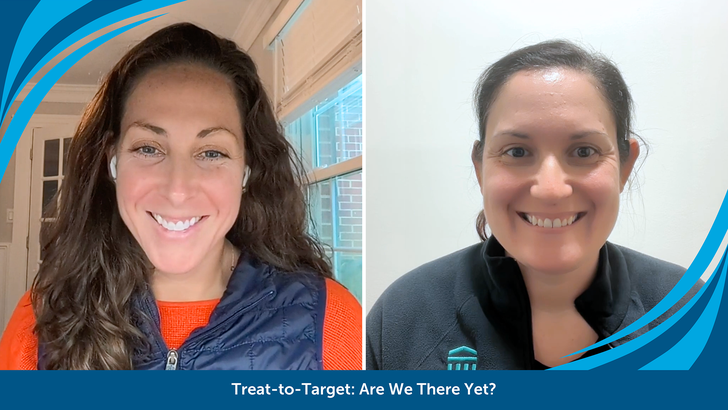
This is CE on reach MD, and I'm Jennifer Geremia. I'm a physician assistant at Brigham and Women's Hospital in the gastroenterology department in the Boston area.
Ms. Orleck:
And I'm Kimberly Orleck, a physician assistant out of Atlanta Gastro.
Treat-to-target is a recommendation approach that is grounded in the STRIDE and STRIDE-II consensus recommendations from the International Organization for the Study of IBD, which defines both short-, intermediate-, and long-term therapeutic goals. It's really a proactive management strategy that talks about regular, objective monitoring in addition to subjective monitoring to help us ensure that we are reaching all targets rather than relying solely on symptom control.
Jen, do you mind kind of sharing, when we think about treat-to-target, how you talk about these short-, intermediate-, and long-term goals with your patients or other providers?
Ms. Geremia:
Absolutely. And that's really, I think, helped to frame expectations, both for ourselves as clinicians but for patients also.
So short-term targets really is getting the acute inflammation under control. So that's going to encompass both patients feeling better, so clinical response or remission, such as reduction in diarrhea, reduction in bleeding, in particular in UC, for example. And then we start getting into how we objectively corroborate those patient-reported outcomes.
So in the more intermediate realm, we're looking at normalization, or at least improvement in biomarkers such as fecal calprotectin and CRP. So again, the marriage between objective and subjective outcomes in the patient.
If we look more long term, so really 6 months and beyond, and really want to assess this definitively at 1 year, so looking at endoscopic healing, mucosal healing in UC, and transmural healing in Crohn's. Is there sustained clinical remission? So again, the marriage between the patient’s reported outcomes and what we're seeing on these objective tests, absence of disabilities such as missing school or work, being able to essentially complete activities of daily life, and restoration of that quality of life. If you're treating a pediatric population, normal growth in children.
And it's not a definitive endpoint, but certainly one that's being looked at as a formal target, but histological healing and remission in ulcerative colitis patients. So not just what the endoscopist is seeing but what we're actually seeing under the microscope, as far as the presence of microscopic inflammation, because we know that changes both long-term outcomes with the disease but reduces cancer risk, and then assessing for that transmural healing in Crohn's. Again, this is not a formal target, but certainly an area of interest and also been included in our more recent studies for new medications in this space.
Ms. Orleck:
Jen, that was so helpful, and I'm just going to reiterate kind of why we've shifted to really achieving this endoscopic healing, right? Because we know if this is our long-term goal, we really see this associated with improved long-term outcomes, including what you mentioned—the sustained clinical remission, this reduced need for surgery, and lower rates of hospitalization and complication. And so we know that, unfortunately, even though patients might feel good, it doesn't necessarily reflect that they're doing well inside. Hence why the STRIDE recommendation has come up regardless of the therapy that the patient is on.
The last thing I want to point out is just the CALM study, because I feel like before we had STRIDE-II with the CALM study, which is kind of a landmark study in Crohn's disease. It showed the superiority of using this treat-to-target strategy with both clinical symptoms and objective markers to guide what we do in our therapy compared to symptom-based management alone. And so essentially using treat-to-target tight control, we saw higher rates of mucosal healing and deeper remission compared to if we just depended on patient symptoms.
So thank you for that. I think it really helps to kind of understand our short-, our intermediate-, and our long-term goals as we're treating patients with IBD.
So treat-to-target really has transformed IBD from our reactive to proactive care, and the challenge now isn't really defining the target; it's making sure that every patient in every setting, regardless of what therapy we do through shared decision-making, gets there in a timely, tailored fashion.
So with that, our time is up. Thank you for listening, and I hope you found our perspectives helpful.
Announcer:
You have been listening to CE on ReachMD. This activity is provided by Prova Education and is part of our MinuteCE curriculum.
To receive your free CE credit, or to download this activity, go to ReachMD.com/CME. Thank you for listening.

 Global Learning Collaborative (GLC) designates this activity for 1.0 contact hour(s)/0.1 CEUs of pharmacy contact hour(s).
 Global Learning Collaborative (GLC) has been authorized by the American Academy of PAs (AAPA) to award AAPA Category 1 CME credit(s) for activities planned in accordance with AAPA CME Criteria. This activity is designated for 1.0 AAPA Category 1 CME credit(s). Approval is valid until 03/19/27. PAs should claim only the credit commensurate with the extent of their participation in the activity.